EDGE HEALTH AI · demonstrated with ConsidraCare & the University of Lahore
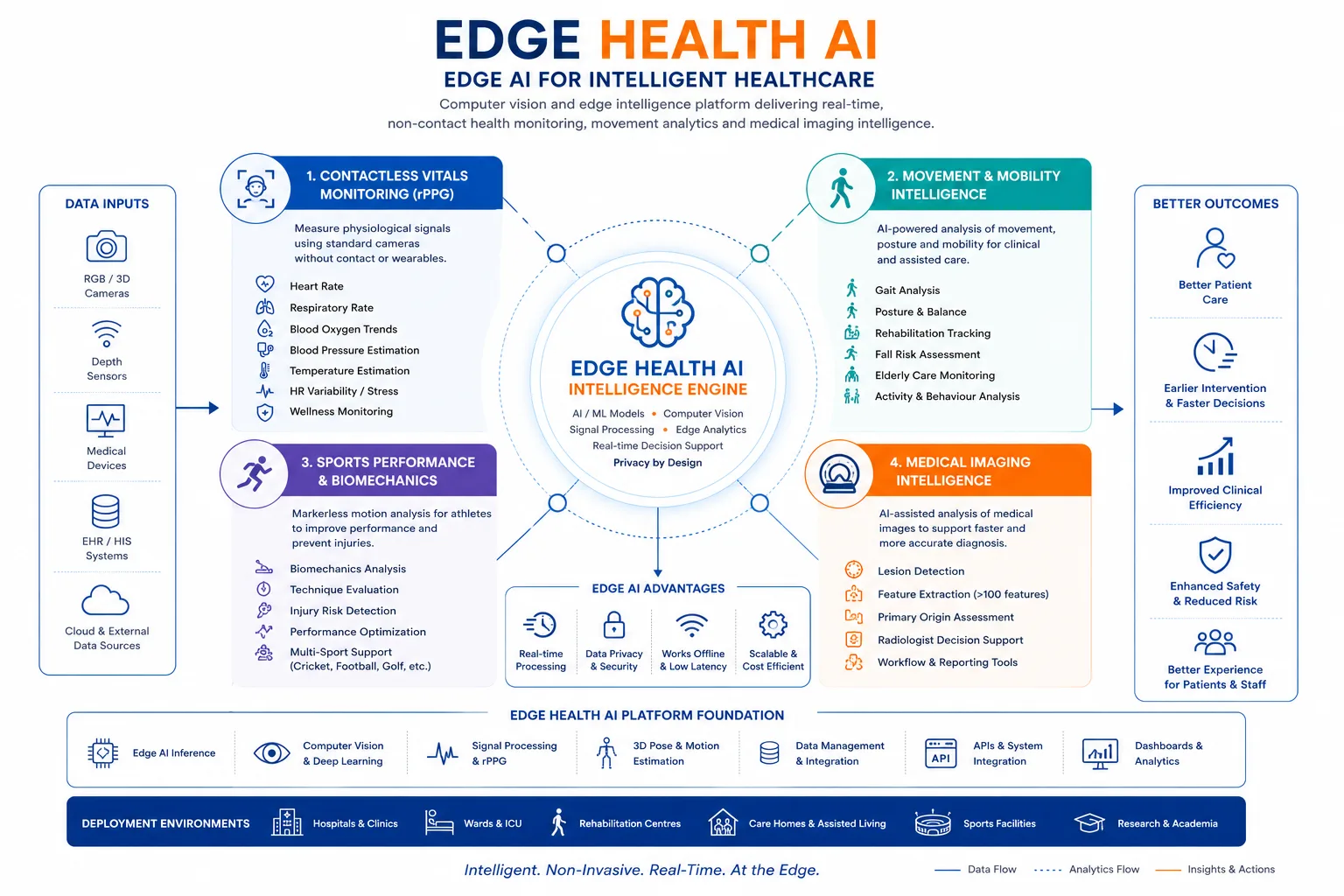
A standard camera, an edge processor, and the right models can read heart rate from a face, score a gait after surgery, flag a fall before it happens, and find a lesion on a CT scan. EDGE HEALTH AI is one platform for all of it — computer vision and physiological sensing processed where the data is generated, so nothing sensitive has to leave the room.
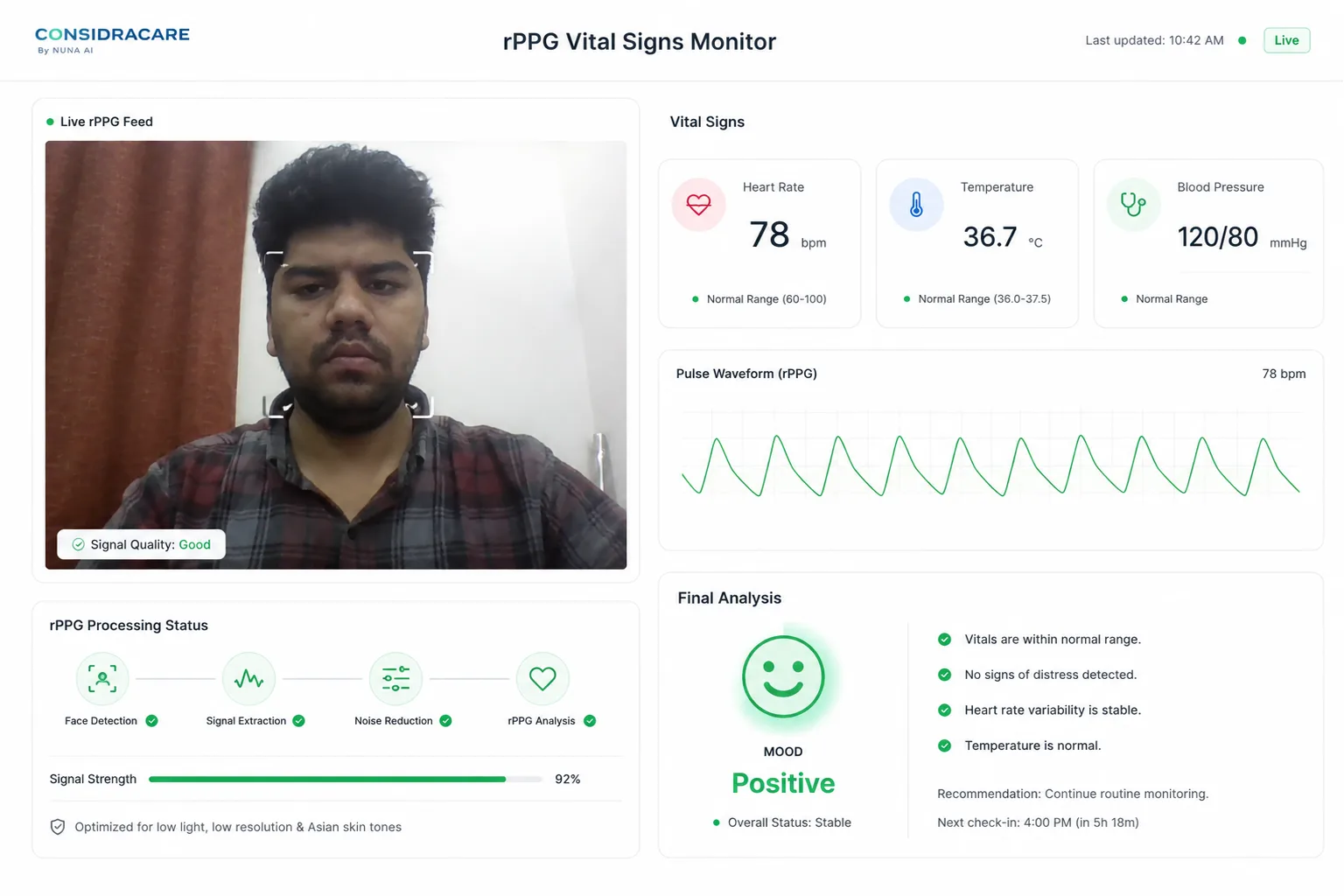
Interface shown is a representative demonstration.

Showcase — ConsidraCare
Developed with ConsidraCare, Canada, and engineered into their live care platform: remote photoplethysmography (rPPG) that reads physiological signals from microscopic colour changes in facial skin — invisible to the human eye, continuous, and non-invasive. The patient simply sits in front of a camera.
What it measures: heart rate, respiratory rate, heart-rate variability, blood-pressure and blood-oxygen estimation, stress indicators, and temperature trends.
Where it fits: hospital wards, telemedicine, elderly care, rehabilitation, and assisted living — continuous observation without disturbing the patient.
Why edge: processing runs on-device, so video never needs to leave the site — privacy by architecture, with the low latency continuous monitoring demands.
Showcase — Medical Imaging
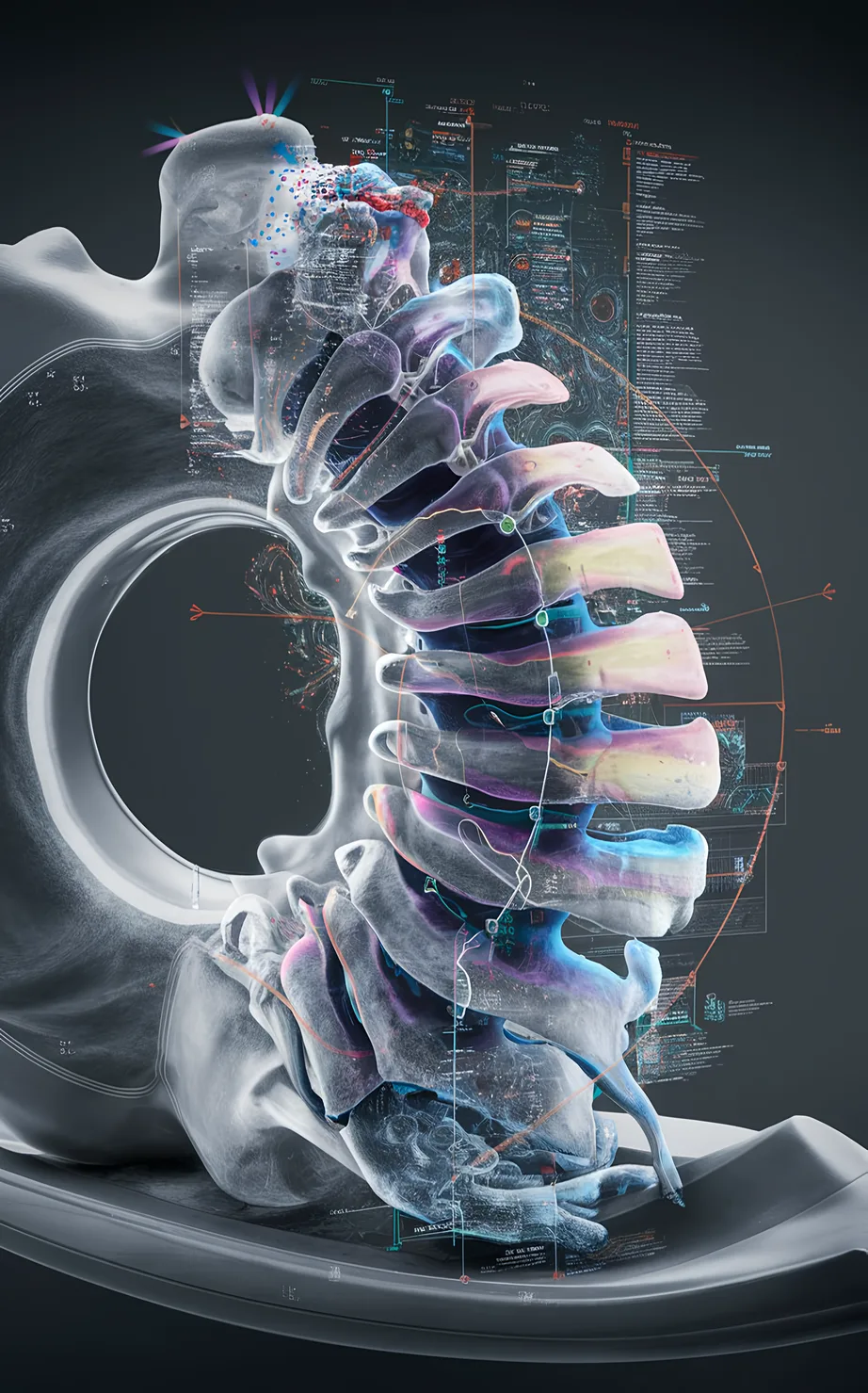
Spinal metastases arrive through the bloodstream — most often from breast, lung, prostate, or kidney primaries — and pinpointing that origin quickly changes patient outcomes. AI-PRO, developed with the University Institute of Radiological Sciences & Medical Imaging Technology at the University of Lahore's Faculty of Allied Health Sciences, applies deep learning to lumbar-spine CT scans to identify metastatic lesions and assess where the primary cancer likely sits.
Analyses 100+ imaging characteristics associated with metastatic disease per scan.
Assists the radiologist — accelerating diagnostic pathways and supporting earlier investigation of primaries, with the clinician making every call.
Product-development proof of concept, built with academic and clinical partners in radiological sciences.
Movement Intelligence
The same pose-estimation engine runs across sports science, rehabilitation, and elderly care: 3D-depth and RGB video analysed for posture, joint movement, and behaviour — no markers, no suits. Deployed work includes cricket action analysis for Madingley Cricket Club (Cambridge, UK), golf swing evaluation, football goalkeeper behaviour with the University of Lahore Sports Science Department, and gait analysis for post-operative orthopaedics.
The Platform
Each showcase runs on the same EDGE HEALTH AI foundation: computer vision, physiological signal processing, deep learning, and pose estimation deployed at the edge — hospital, clinic, care home, or training ground — with privacy preserved by keeping raw video on-site.
rPPG physiological monitoring from standard RGB cameras — no wearables, continuous, and comfortable for the patient.
AI-assisted observation across hospital wards: fewer manual rounds, earlier intervention.
Mobility, behavioural change, and fall prediction supporting independent living and the carers behind it.
Markerless assessment of walking patterns and recovery after orthopaedic or neurological procedures — objective measurements, not estimates.
Biomechanical analysis for performance and injury prevention — cricket, golf, football, and general human performance.
Deep-learning interpretation of medical imaging, from lesion recognition to diagnostic decision support.
Platform interfaces shown are representative demonstrations — client data and production dashboards remain confidential under NDA.
Edge AI turns the cameras and rooms you already have into continuous, privacy-preserving clinical observation. Tell us about your environment.